American Ginseng as a Natural Remedy
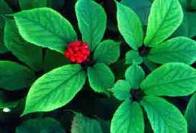
Description: American Ginseng is a smaller version of its Asian cousin. It is a perennial plant with a stem which grows to about two feet tall, and has a large, fleshy root. The leaves are made up of anywhere from three to seven sharp toothed, lance shaped leaflets. They have yellow-green flowers which bloom in June or July, followed by red berries.
Part used: The root of this herb is the part used in herbal medicine.
Where found: American ginseng is found from Maine to Georgia and from Oklahoma to Minnesota. Unfortunately, it is now becoming an endangered species throughout much of this region.
Traditional uses: American ginseng is a calmer version of this herb than Chinese (also known as Korean or red) ginseng for people with high blood pressure or for use during the summer months. Its primary use is for stimulating mental efficiency, and for increasing stamina and energy.
This herb promotes appetite and is helpful for rheumatism, headaches, colds, coughs, bronchitis, constipation, lung problems, cystitis, and menopausal symptoms. It is also helpful when used as a tea to help treat nausea and vomiting. It has also been used extensively as an ingredient in "love potions."
Diabetes. Researchers believe that this herb may be a very effective alternative to the use of insulin in treating type 2 diabetes.
This herb also contains compounds which help to regulate both the strength of the heartbeat, as well as the blood pressure, making it an effective treatment for high blood pressure.
Various groups have used this herb over the centuries to treat infertility in women, although no actual studies have been performed to validate this effect. It is known, however, that it contains compounds which stimulate the pituitary gland to stimulate the growth of the uterine lining.
This herb, like its Chinese counterpart, have long been used to increase sex drive in men.
This herb, also like other forms of ginseng, have been used to restore health and vitality to people who have been exposed to long periods of stress. Research indicates that this herb helps the body adapt to different temperatures, as well as to stress.
Other considerations: This herb is most commonly available as a tincture, although many sources make the root available for use as a tea.
This herb should be avoided in all of its forms if your stomach has trouble producing enough acid to digest your food properly.
Since this herb stimulates fertility, it should also be avoided by women during the first week of taking a new brand of birth control pills.
Some people experience insomnia when taking this herb, especially if it is combined with anything containing caffeine. This side effect can be lessened by either reducing the dosage being taken, or avoiding taking it later in the day.
This information is not intended to diagnose or treat any specific condition, nor is it intended to replace the advice of your healthcare professional.
Sources
Balch, Phyllis A., CNC. "Prescription for Nutritional Healing". Garden City, NY.: Avery Publishing Group, 2006
Ritchason, Jack, ND. "The Little Herb Encyclopedia". Pleasant Grove, UT.: Woodland Health Books, 1995
Encyclopedia.com