Alfalfa as a Natural Remedy
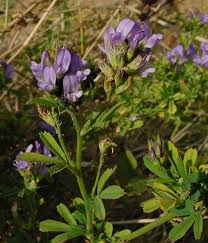
Description: Alfalfa is a perennial herb that grows to be about three feet tall. It has 3-lobed leaves, blue-violet or yellow flowers, and spiraling seed pods.
Part used: All of the plant that is above the ground is used in herbal medicine.
Where found: This herb was originally found in the Middle East. By the sixteenth century it was being grown in England, and in 1736 it came to the thirteen colonies which would later become the United States. It is grown in many parts of the world today.
Traditional uses: Its leaves are rich in minerals, such as calcium, magnesium, and potassium, as well as other important nutrients like carotene. The tablets are rich in protein and vitamins A,D,E, and K. The extract is a good source of chlorophyl and carotene. The leaves also contain eight essential amino acids.
This herb is an immune system stimulant. It also promotes normal blood clotting, and is an excellent blood purifier. It also helps the body to break down and absorb proteins, fats, and carbohydrates. It is also a good choice as a mineral supplement.
This herb has helped many people suffering from arthritis, and has been found to help in healing numerous illnesses, including ulcers, gastritis, liver disorders, bleeding gums, hemorrhoids, asthma, high blood pressure, eczema, anemia, constipation, body and breath odor, infections, burns, athlete's foot, and cancer. It also acts as a diuretic, and helps with urinary and bowel problems.
It has also been proven effective in dealing with other specific health problems, including atherosclerosis, cancer, diabetes, endometriosis, menopause related problems, nosebleeds, and osteoporosis.
This herb is very useful for replacing vitamin K which has been depleted by taking a variety of different kinds of prescription drugs.
Other considerations: Alfalfa should be taken in capsules or eaten as fresh raw sprouts which have been rinsed thoroughly to remove mold. Unsprouted seeds should never be eaten, as they contain a toxic amino acid.
This herb should be avoided by pregnant women and people with hay fever or women suffering with PMS (premenstrual syndrome). It should also be avoided by people suffering with autoimmune disorders.
This herb should not be taken by those taking prescription anticoagulants, as it counteracts these medications.
This information is not intended to diagnose or treat any specific condition, nor is it intended to replace the advice of your healthcare professional.
Sources
Balch, Phyllis A., CNC. "Prescription for Nutritional Healing". Garden City, NY.: Avery Publishing Group, 2006
Ritchason, Jack, ND. "The Little Herb Encyclopedia". Pleasant Grove, UT.: Woodland Health Books, 1995
Encyclopedia.com